When groceries, gasoline and other essentials already cost more, higher interest rates can feel like another squeeze on the household budget. The Bank of Canada raises rates to slow borrowing and spending, hoping to prevent prices from rising persistently across the economy. It is an uncomfortable trade-off: more financial pressure today, with the aim of greater price stability later. But the Bank’s policy rate is only part of the mortgage story. Fixed mortgage rates are strongly influenced by the bond market, where expectations about inflation, the economy and world events shape borrowing costs.
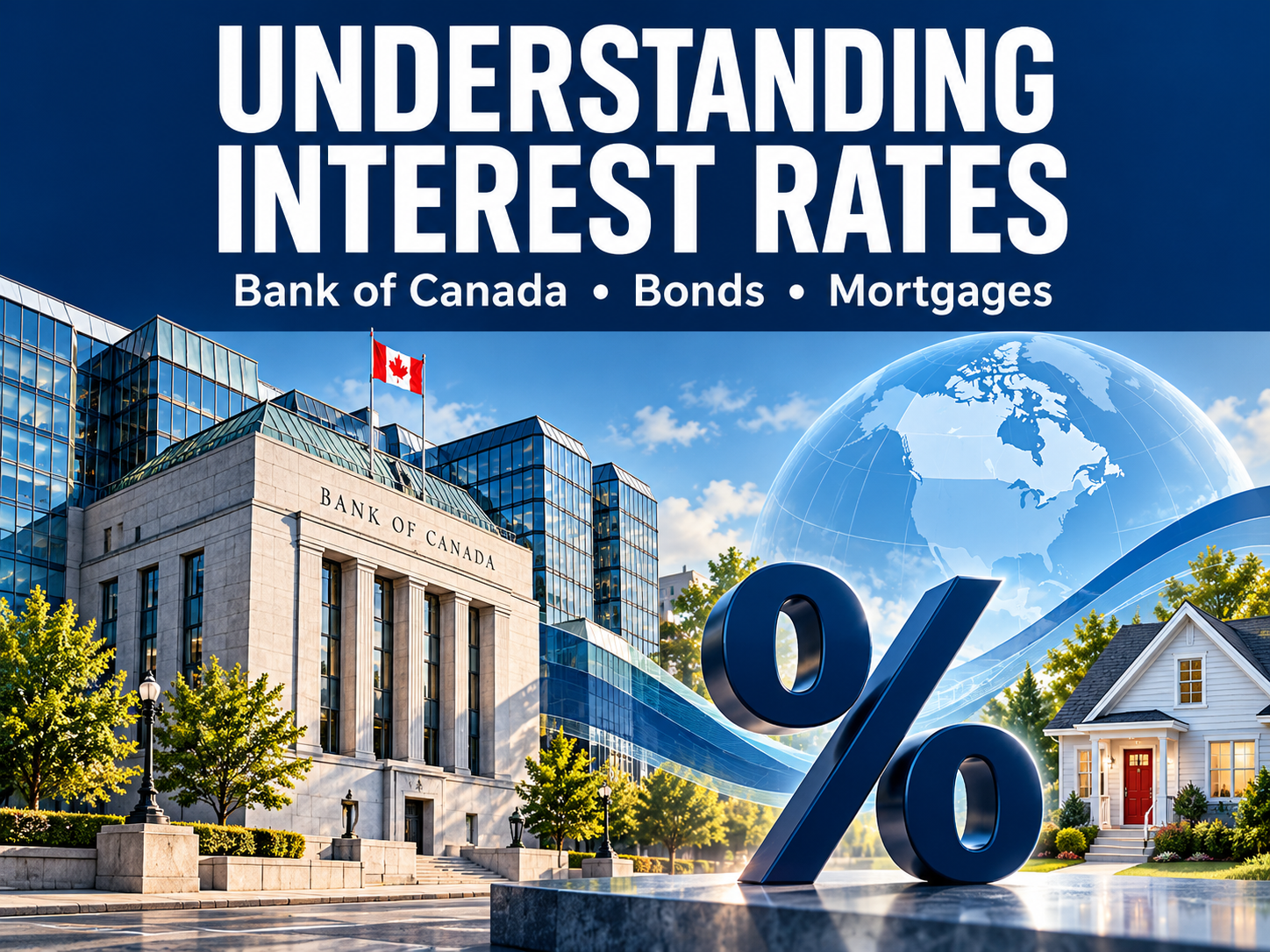
Understanding Interest Rates
The Bank of Canada, Bond Markets and Your Mortgage
1. What does the Bank of Canada do?
The Bank of Canada is Canada’s central bank. Its responsibilities include issuing banknotes, supporting financial stability and conducting monetary policy—the decisions intended to keep inflation low and predictable.
It does not provide mortgages or set the rate your lender must charge. Its main interest-rate tool is the policy rate, which influences borrowing costs throughout the economy.
The federal government and the Bank jointly establish the monetary-policy framework. Within that framework, the Bank independently makes its interest-rate decisions.
2. Why raise rates when people are already stretched?
Higher interest rates make borrowing more expensive and saving more attractive. Households may postpone major purchases, while businesses may delay expansion. As spending slows, businesses have less room to increase prices without losing customers.
Think of it as easing pressure on the economy’s accelerator. The intention is to slow price increases before they become harder to control.
However, the costs are real. Mortgage and loan expenses can rise quickly, while the full effect on inflation can take roughly 18 to 24 months. A household that has already cut back may feel additional pressure long before seeing a benefit.
3. How can higher rates help if oil and food are the problem?
Higher interest rates cannot produce more oil, improve a harvest or end a conflict. What they can do is restrain spending and reduce the risk that an initial price shock spreads more widely.
For example, expensive diesel raises the cost of delivering groceries. If fuel remains expensive, transport companies and retailers may pass more of that cost to customers. The Bank watches for signs that these increases are becoming persistent across many goods and services.
There is a balancing act: higher essential costs already leave consumers with less to spend elsewhere. Raising interest rates adds further restraint, so the Bank must weigh inflation risks against the possibility of weakening the economy too much.
4. Inflation is slowing—why does everything still feel expensive?
Lower inflation usually means prices are rising more slowly, rather than returning to their previous levels.
If a hypothetical grocery basket rises from $100 to $110, another 2% increase takes it to $112.20. The earlier increase remains.
The Bank looks at two types of inflation measures:
- Headline inflation: The overall change in the Consumer Price Index, covering a weighted basket of household purchases.
- Core inflation: Measures that help identify the underlying trend by reducing the influence of unusually large price movements.
Core measures do not suggest that food or fuel costs are unimportant. They help the Bank judge whether inflation is concentrated in a few areas or spreading throughout the economy.
5. Who makes the Bank’s interest-rate decisions?
The Bank’s Governing Council, comprising the Governor, Senior Deputy Governor and Deputy Governors, makes monetary-policy decisions by consensus.
The Governor is appointed by the independent directors on the Bank’s Board, subject to federal Cabinet approval, for a renewable seven-year term. The Board oversees the institution’s management and finances; Governing Council makes the rate decisions.
Under the monetary-policy agreement in effect through December 2026, the Bank aims for 2% inflation, within a range of 1% to 3%, over time. Low, stable inflation is intended to support sustainable economic growth and employment.
6. How does the policy rate affect variable mortgages and lines of credit?
The Bank’s policy rate influences lenders’ prime rates. Many variable mortgages and lines of credit are priced at prime, plus or minus an amount specified in the contract.
When the applicable prime rate changes, the borrower’s interest rate generally follows.
Type of borrowing | What a higher interest rate generally means |
Variable mortgage with adjustable payments | Payments increase. |
Variable mortgage with fixed payments | More of the payment goes to interest and less reduces the balance; payment adjustments may eventually be required. |
Variable-rate line of credit | Interest costs increase on the outstanding balance. |
Existing fixed-rate mortgage | The contractual rate remains unchanged until the term ends. |
As a simple illustration, a quarter-point increase adds approximately $21 a month in interest per $100,000 borrowed, assuming an unchanged balance. The exact change in a mortgage payment depends on the contract and remaining amortization.
7. Why are fixed mortgage rates different?
Fixed mortgage rates are strongly influenced by Government of Canada bond yields, particularly yields for a similar term. The five-year bond yield is an important benchmark for five-year fixed mortgages.
Think of bond yields as a wholesale price guide for longer-term borrowing. Lenders use that guide alongside their own funding costs, operating expenses, risk and competition when setting mortgage offers.
That is why fixed mortgage rates can change even when the Bank of Canada leaves its policy rate alone.
8. What is a bond—and why does its yield change?
A bond is essentially a loan from an investor to a government or company. A conventional fixed-rate bond pays scheduled interest and repays its principal at maturity.
Investors can also buy and sell bonds before maturity. Their prices change as investors compare them with other opportunities.
If new bonds offer better returns, an older bond generally becomes less valuable. Its price falls, increasing the return—or yield—available to someone buying it.
Bond prices and yields move in opposite directions: prices down, yields up; prices up, yields down.
9. What moves Canadian bond yields?
Investors look ahead, assessing what their money is likely to earn and what it will buy in future years.
The main influences include:
- Inflation: Persistent inflation can lead investors to demand higher returns.
- Expected central-bank decisions: Anticipated rate increases or cuts can move yields before an announcement.
- Economic conditions: Strong growth can support higher yields; a slowdown can put downward pressure on them.
- Government borrowing: A larger supply of bonds may require higher yields to attract sufficient buyers.
- Global developments: US interest rates, trade policies, energy prices and international uncertainty all influence Canadian markets.
The United States matters particularly because its bond market is enormous and closely connected to Canada’s. Canadian mortgage costs can therefore change in response to developments south of the border.
Uncertainty does not always push yields higher. An inflation scare may raise them, while a recession scare may encourage investors to buy government bonds, pushing yields down.
10. How do banks respond?
When bond yields and funding costs rise, lenders may increase their fixed mortgage offers. When those costs fall, lenders may have room to reduce rates.
The response is not automatic or identical across lenders. Competition, funding arrangements and the type of mortgage also affect pricing.
Importantly, a change in advertised fixed rates does not change the rate on an existing fixed mortgage during its term. It affects the offers available for new borrowing, refinancing and renewal.
11. Fixed, variable—or a combination?
The choice depends on your budget, plans and ability to absorb higher costs, as well as the actual rates offered.
Choice | Main advantage | Main consideration |
Fixed | A known interest rate and scheduled payments for the term. | You do not automatically benefit if rates fall, and early-exit penalties can be substantial. |
Variable | Interest costs can fall when the applicable prime rate falls. | Costs can also rise; payments may increase or repayment of principal may slow. |
Combination | Part of the mortgage is protected from rate changes, while part remains variable. | The arrangement can be more complicated and harder to transfer between lenders. |
Choosing fixed is similar to securing a price for a set period. Choosing variable means accepting a price that can move. A combination divides that exposure.
A variable mortgage’s conversion feature does not guarantee access to today’s fixed rate later. Always check the rate and conditions available when converting.
12. What should borrowers focus on?
No one can reliably predict the exact path of mortgage rates. Fixed rates may anticipate changes well before they happen, and world events can quickly alter the outlook.
Before choosing or renewing a mortgage, consider:
- Whether your budget could handle higher interest costs.
- How long you expect to keep the property and mortgage.
- Prepayment privileges, portability and penalties.
- The total cost under several possible rate paths.
A suitable mortgage should leave your household comfortable enough to manage an uncertain future. A competitive rate matters, but so do flexibility, predictable expenses and room in your budget.
This article provides general information. Mortgage terms and lender policies vary; review your options with a qualified mortgage professional.
Further reading: Bank of Canada: Monetary policy · What determines mortgage rates · Choosing a mortgage

Quick Links
© 2026
Sean Holden.
All rights reserved.
| Privacy Policy | Real Estate Websites by myRealPage
 The data relating to real estate on this website comes in part from the MLS® Reciprocity program of either the Greater Vancouver REALTORS® (GVR), the Fraser Valley Real Estate Board (FVREB) or the Chilliwack and District Real Estate Board (CADREB). Real estate listings held by participating real estate firms are marked with the MLS® logo and detailed information about the listing includes the name of the listing agent. This representation is based in whole or part on data generated by either the GVR, the FVREB or the CADREB which assumes no responsibility for its accuracy. The materials contained on this page may not be reproduced without the express written consent of either the GVR, the FVREB or the CADREB.