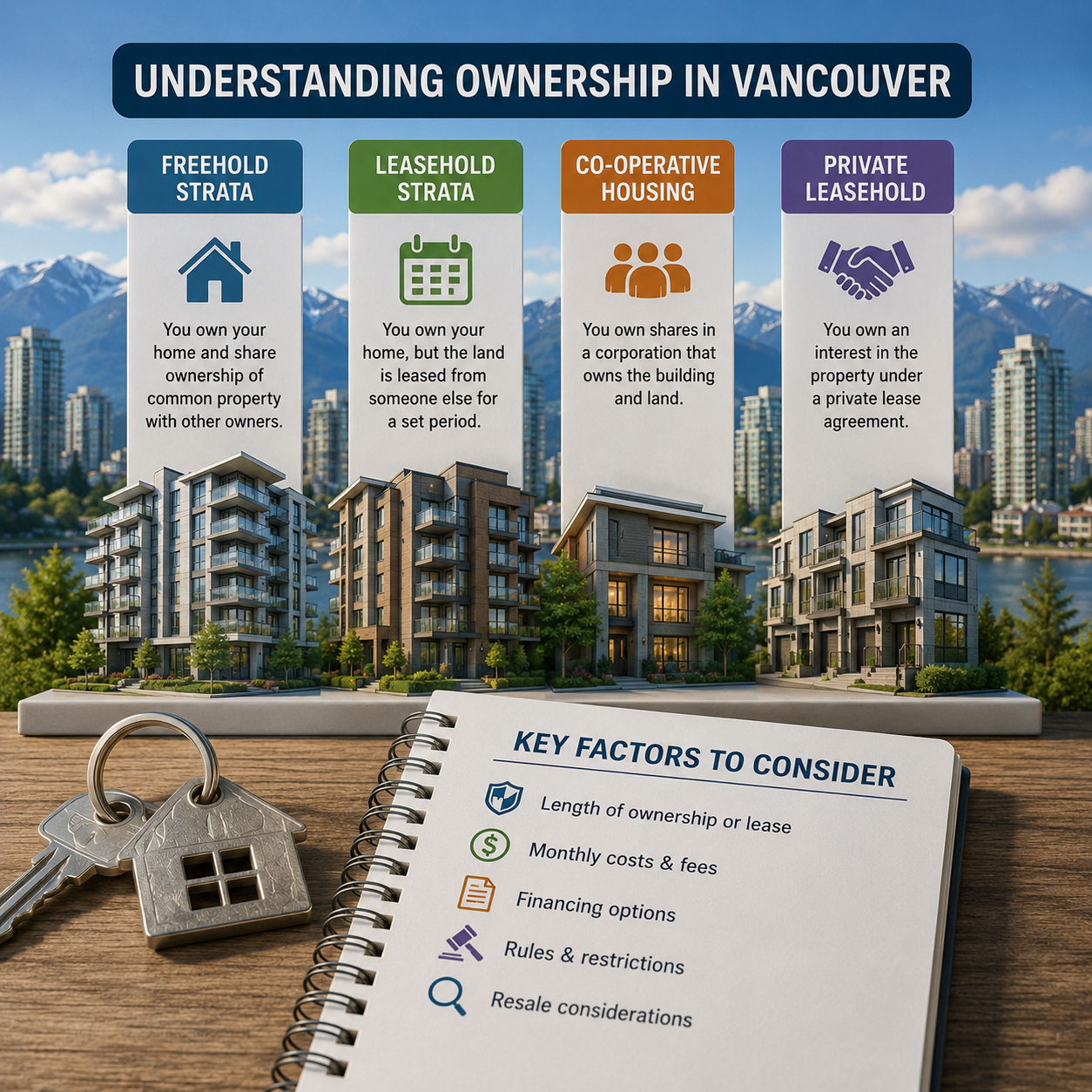
Understanding Freehold, Leasehold & Co-op Ownership in Vancouver

A practical guide for Vancouver home buyers

Understanding Freehold, Leasehold & Co-op Ownership in Vancouver


Most Vancouver condos and townhomes are conventional freehold strata properties, but not all of them. Buyers may also encounter City of Vancouver leaseholds, Crown or other government leaseholds, leases on Indigenous Nation lands, private or corporate leaseholds, and market co-operatives. There are even detached homes on leased land, including properties on Musqueam lands in southwest Vancouver.

The homes themselves can look remarkably similar. The legal and financial interest you are buying can be very different. That difference can affect financing, down payment, monthly costs, taxes, resale, rentals, pets and, with a leasehold, what happens when the lease eventually expires.


1. The Basic Difference: Freehold, Leasehold and Co-op

Freehold strata

With a conventional freehold strata, you receive registered title to your strata lot and share ownership of the common property and common assets with the other strata owners. The strata corporation manages the common property, owners pay strata fees and contribute to the contingency reserve fund, and major work may also be funded by special levies. There is no predetermined expiry date on the ownership.

Leasehold

With a leasehold property, someone else owns the underlying land. You are purchasing an interest for a specified period under a lease. The landowner may be the City of Vancouver, the provincial or federal government, an Indigenous Nation or related entity, or a private landowner or corporation.

Simply knowing that a property is leasehold is not enough. A buyer needs to know who owns the land, how long the lease runs, how many years remain, whether the lease is prepaid, whether ground rent can change, and what the lease says about renewal, resale and expiry.

Market co-op

A market co-op is different again. Instead of receiving title to an individual strata lot, you generally purchase shares in a corporation together with the right to occupy a particular home. The corporation owns or leases the property, and your rights are governed by its corporate documents, bylaws and occupancy agreement.

2. Vancouver Has Several Different Types of Leasehold

Vancouver leaseholds should not all be treated as though they are the same. Many were originally created with long terms, commonly 99 years, and some still have many decades remaining. A long prepaid lease with 60 or 70 years left is a very different proposition from a lease with 10 or 15 years remaining.

False Creek South - City of Vancouver

False Creek South is the best-known Vancouver example. Much of the City-owned land there was developed in the 1970s and 1980s using leases that were typically about 60 years. The City currently identifies 12 residential leasehold strata buildings containing 669 units, with the great majority of the leases prepaid and most City leases in the neighbourhood expiring between 2036 and 2046.

These are still strata properties, with strata corporations, councils, bylaws, budgets, contingency reserve funds and special levies. The important difference is that the City owns the land beneath them.

Other City of Vancouver leaseholds

City-owned leasehold properties also exist outside False Creek South, including parts of East and South Vancouver. Some were established under much longer original lease terms and may still have many years remaining. The words 'City of Vancouver leasehold' identify the landowner; they do not tell you the terms of the lease.

Crown and other government leaseholds

Some Vancouver properties are on land owned by the provincial or federal Crown or another public authority. Many long-term government leases were originally established for lengthy terms, often 99 years. A long prepaid Crown lease may be quite financeable and may feel much like ordinary strata ownership in day-to-day use, but legally the land is still leased and the remaining term matters.

Indigenous Nation lands

Residential development on Indigenous Nation lands includes condos, townhomes and, in some locations, detached homes. The well-known Musqueam residential leases in southwest Vancouver provide a historical example of why rent-review clauses matter: some older leases eventually produced very large rent increases when rent was reset using land-value formulas. Modern developments can have very different structures, so one Indigenous-land lease should never be assumed to operate like another.

Private and corporate leaseholds

Private leaseholds can be different again. Depending on the legal structure, maintenance, insurance and major capital expenses may not be handled through the familiar strata corporation and contingency reserve fund model. Buyers need to establish who pays for items such as roofs, plumbing, mechanical systems and other major repairs, and what the agreement says will happen at the end of the term.

Prepaid vs Non-Prepaid Leashold
3. Prepaid vs. Non-Prepaid Leasehold

A prepaid lease generally means the ground rent has been paid in advance for a specified period. The buyer normally does not make separate regular ground-rent payments during the remaining prepaid term, but the lease still has an expiry date.

With a non-prepaid lease, ground rent continues to be payable. The important question is not only what the rent is today, but when it can be reviewed and how the new rent is calculated. A lease tied to future land values can produce very different costs over time.

4. What Happens When the Lease Ends?

There is no single answer. The result depends on the legal structure and the particular lease.

For leasehold stratas governed by Part 12 of BC's Strata Property Act, the leasehold landlord may renew the strata lot lease. If it elects not to renew, the legislation requires the landlord to purchase the leasehold tenant's interest. The purchase price is determined by the basis set out in the lease or filed schedule; if no basis is provided, the Act provides for fair-market-value treatment as if the strata lot lease did not expire.

False Creek South provides a practical example. Under the City's current lease-end terms, building ownership transfers to the City and leaseholders receive a Leasehold Interest in the Strata Lot (LISL) payment intended to compensate them for the fair market value of the improvements at lease end.

Other Indigenous Nation, private or corporate leases may have different end-of-term provisions. A lease may provide for renewal, compensation, transfer of improvements or another arrangement. Buyers should not assume either that the landowner must buy them out or that they automatically lose everything. The lease itself must be reviewed.

5. Financing: Can You Actually Get a Mortgage?

A mortgage pre-approval does not mean a lender will finance every property. The lender must approve both the borrower and the property being offered as security.

Freehold strata properties are generally the most straightforward to finance. Long-term leasehold stratas can also be financeable, particularly where the lease is prepaid and many decades remain. As the remaining lease term shortens, however, lender options can narrow, amortization may need to be shorter, a larger down payment may be required, or conventional financing may become unavailable.

False Creek South illustrates the issue clearly. If a property has only about 10 years remaining on its lease, a conventional 25-year mortgage creates an obvious problem: the lender's security could end long before the normal mortgage amortization. A cash buyer may still be able to purchase, but should also consider whether the next buyer will be able to obtain financing.

Co-op financing is different because there is no individually titled strata lot against which a conventional mortgage can be registered. Fewer lenders may participate, and substantial down payments are often encountered. In my Vancouver experience, some market co-ops have required 35% or more down, while others may effectively require an all-cash purchaser. Requirements vary by lender and co-op, so financing should be confirmed before making an unconditional commitment.

6. Understanding Market Co-ops

It is important to distinguish a market co-op from Vancouver's many non-profit, subsidized or rental-style housing co-operatives. In a market co-op, the purchaser buys shares in a corporation together with occupancy rights, and those shares can generally be resold subject to the corporation's rules. In a non-market housing co-op, a resident generally becomes a member and pays a housing charge but is not buying a marketable ownership interest that can later be sold at market value.

A market co-op may also have more control over who becomes a shareholder. Depending on its governing documents, a purchaser may need to apply for membership, provide financial information, attend an interview or receive board approval.

Historically, many market co-ops have restricted or prohibited rentals or subletting. BC's current rule preventing strata corporations from restricting long-term rentals applies to strata corporations; a co-op is a different legal structure and its own occupancy and subletting rules need to be reviewed.

Pet rules can also be restrictive, and renovations may require corporation approval. Buyers should review the co-op's financial statements, debt, insurance, litigation, planned capital work and how major expenditures are funded. It is also important to establish whether the co-op corporation owns the underlying land or leases it from someone else.

7. Taxes and Buyer Protections

The ownership structure can also affect closing costs and buyer protections. A conventional market co-op transaction is generally a purchase of corporate shares and occupancy rights rather than a transfer of an individually titled parcel. As a result, the usual Property Transfer Tax associated with registering a transfer of real property generally does not arise on the purchaser's acquisition of the co-op shares. Buyers should still obtain legal and tax advice for the particular transaction.

Vancouver's Empty Homes Tax also works differently for a co-op because the co-op property is generally not divided into separately titled taxable strata lots. The City treats a housing co-operative at the property level for Empty Homes Tax purposes rather than treating each shareholder as the owner of a separate strata parcel.

There is also an important difference under BC's Home Buyer Rescission Period. Residential property located on leased land and leasehold interests in residential real property are exempt from the statutory three-business-day rescission period. Buyers of leasehold property should therefore

8. Think About Resale Before You Buy

Leasehold and market co-op properties can offer very good housing and, for the right buyer, good value. They may provide a larger home, a better location, waterfront living or an entry price well below a comparable freehold property.

The lower price, however, should be understood rather than simply celebrated. With leasehold, ask how much time will remain when you eventually sell, whether financing will still be available, whether a rent review is approaching and what happens at expiry. With a co-op, consider the down payment the next purchaser may need, whether rentals or pets are restricted, whether board approval is required and how those rules affect the future buyer pool.

The question is not simply, 'Can I buy this property today?' It is also, 'Who will be able to buy it from me when I am ready to sell?'

9. A Quick Comparison


Freehold Strata

Leasehold

Market Co-op

What you acquire

Title to strata lot + shared land interest

Time-limited leasehold interest

Shares + occupancy rights

Underlying land

Owned collectively

Owned by landowner

Corporation may own or lease

Expiry

No predetermined expiry

Yes

Depends on corporation's land tenure

Financing

Usually easiest

Depends heavily on remaining term

More restricted/building-specific

Ground rent

No

Prepaid or ongoing

May apply indirectly if corporation leases land

Purchaser approval

Generally no

Generally no

May be required

Rentals

Strata cannot restrict long-term rentals

Depends on structure/lease

Can be restricted

Pets

Check bylaws

Check bylaws/lease

Check co-op rules

Resale

Conventional market

Lease term affects demand and financing

Financing and rules affect buyer pool

10. Questions to Ask Before You Buy
  • Who owns the land, and what exactly am I purchasing?
  • How many years remain on the lease?
  • Is the lease prepaid or non-prepaid?
  • If ground rent continues, when is it reviewed and how is it calculated?
  • What happens when the lease expires, and is compensation provided?
  • Will my lender finance this property on acceptable terms?
  • How might financing change before I eventually sell?
  • For a co-op, what are the membership, rental, pet and renovation rules?
  • Does the co-op own or lease its land?
  • What are the financial condition, debt and future capital obligations of the strata or co-op?
The Bottom Line

Freehold, leasehold and market co-op homes can all be sensible choices. They are simply different forms of ownership, and those differences can have real financial and practical consequences.

A freehold strata purchaser owns a strata lot and shares in the land. A leasehold purchaser acquires an interest for a defined period while someone else owns the land. A market co-op purchaser generally owns shares in a corporation together with the right to occupy a particular home.

The home may look exactly the same. What you are actually buying may be completely different. Before deciding whether the price represents good value, understand the ownership, the financing, the rules, the future costs and the eventual resale.

Important:

This guide is general information only. Leasehold and co-operative ownership can involve property-specific legal, tax and financing issues. Buyers should obtain appropriate legal, tax and financing advice before committing to a purchase.

Reciprocity Logo The data relating to real estate on this website comes in part from the MLS® Reciprocity program of either the Greater Vancouver REALTORS® (GVR), the Fraser Valley Real Estate Board (FVREB) or the Chilliwack and District Real Estate Board (CADREB). Real estate listings held by participating real estate firms are marked with the MLS® logo and detailed information about the listing includes the name of the listing agent. This representation is based in whole or part on data generated by either the GVR, the FVREB or the CADREB which assumes no responsibility for its accuracy. The materials contained on this page may not be reproduced without the express written consent of either the GVR, the FVREB or the CADREB.